Revenue-Based Financing: The Asset Class Investors Can No Longer Ignore
For most of its history, the merchant cash advance sat on the fringes of finance. It was the product small businesses turned to when the bank said no, funded by a handful of specialist shops and their private backers.

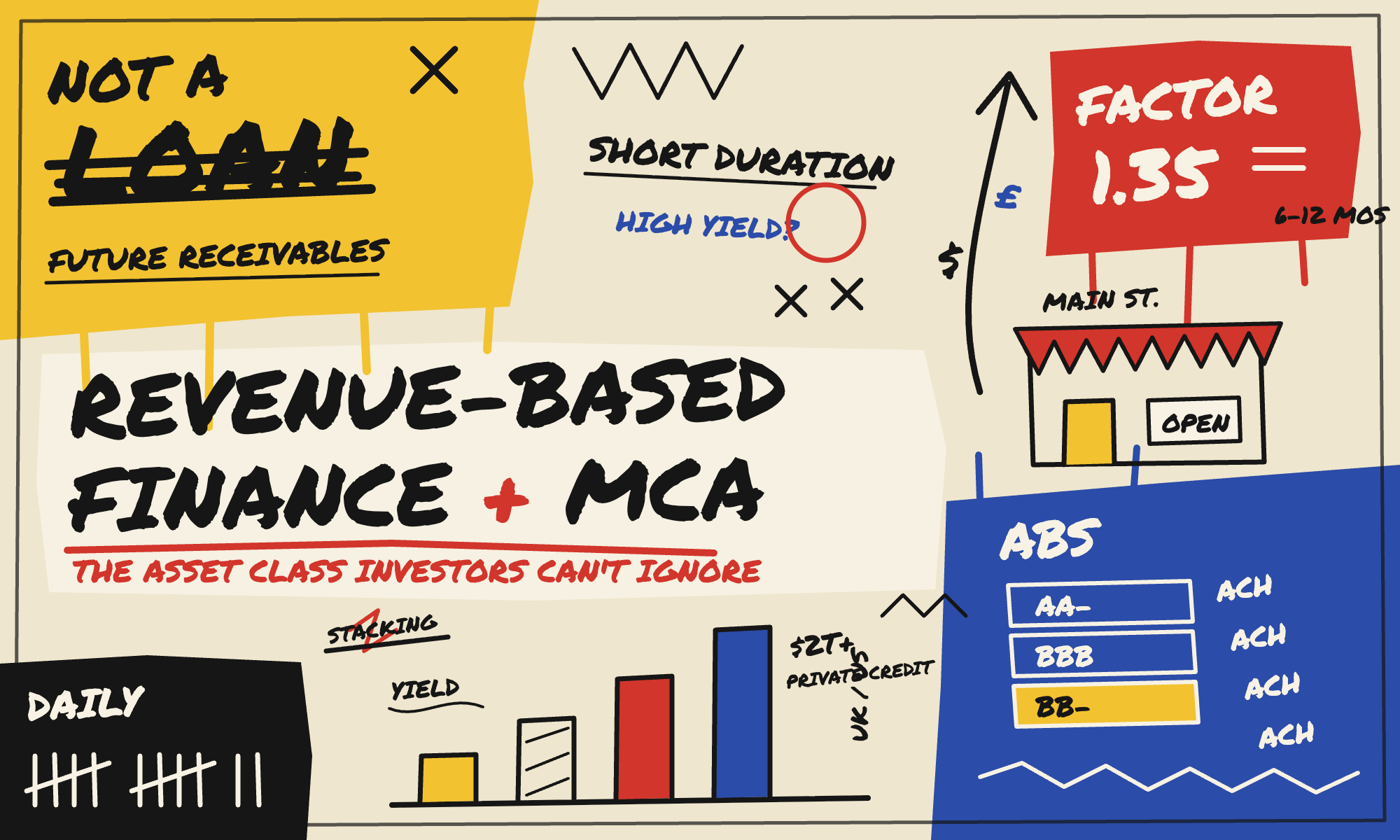
For most of its history, the merchant cash advance sat on the fringes of finance. It was the product small businesses turned to when the bank said no, funded by a handful of specialist shops and their private backers. That picture has changed. Revenue-based financing (RBF) and MCA are now being packaged into rated bonds, bought by institutional credit funds and discussed in the same breath as other private credit strategies.
The reason is simple. Investors want yield, short duration and cash flow that does not move in lockstep with public markets. Capital advanced against a business's future sales offers all three, if it is underwritten and serviced well. This article looks at why the asset class is attracting more money, how investors are getting exposure, and what separates a good portfolio from a bad one.
What investors are actually buying
An MCA is not a loan. The funder buys a fixed amount of a business's future receivables at a discount, then collects them as the business trades. A merchant might receive $100,000 today in exchange for $135,000 of future sales, a factor rate of 1.35.
Collection happens through a daily or weekly ACH debit, or a split of card-processing settlements. Most advances pay back in 6 to 12 months, so the capital turns over more than once a year.
Revenue-based financing works on the same principle. Repayments are a share of revenue rather than a fixed instalment, and the total payback is capped. RBF is more common with e-commerce and SaaS businesses; MCA with restaurants, retail, trades and healthcare practices. For an investor, both are exposures to small-business cash flow, priced for risk and short in duration.
A market growing on every estimate
Research houses disagree on how big the market is, but none of them think it is shrinking. Global MCA estimates for 2026 run from about $21 billion to $46 billion. Revenue-based financing is smaller but growing faster, with forecasts above 20% a year.
Segment | Source | 2026 size (US$) | Forecast | Growth rate (CAGR) |
|---|---|---|---|---|
MCA | 22.2bn | 41.8bn by 2035 | 7.3% | |
MCA | 21.5bn | 35.2bn by 2033 | 7.3% | |
MCA | 32bn | 59bn by 2033 | 9.5% | |
MCA | 46.1bn | 68.1bn by 2031 | 8.1% | |
RBF | 21.1bn | 56.7bn by 2031 | 21.9% | |
RBF | 15.9bn | — | 62.2% (2025–26) |
North America dominates. Mordor puts it at 81% of the global MCA market in 2025, with Asia-Pacific the fastest-growing region.
The wider tide matters too. Moody's expects private credit assets to exceed $2 trillion in 2026 and approach $4 trillion by 2030, and names asset-backed finance as a core part of that growth. Small-business receivables are one of the asset types that shift is pulling in.
Why investors are paying attention
The appeal comes down to four features that are hard to find together elsewhere in credit.
- High yield. Factor rates of roughly 1.2 to 1.5 on advances of 6 to 12 months translate into gross annualised returns well above most private credit. After losses and servicing, a well-run book still clears many direct-lending targets.
- Short duration. Capital comes back within months, not years. Investors can recycle it, reprice it as conditions change, or step away quickly if performance slips.
- Self-amortising cash flow. Money arrives daily or weekly from day one. There is no bullet maturity to refinance and no long wait to learn whether a position is performing.
- Diversification. A portfolio can hold hundreds or thousands of small positions across sectors and regions. Returns are driven by small-business trading, not by rate moves or public equity markets.
The gap left by banks adds to the case. Many small businesses cannot get fast working capital from their bank, and that unmet demand gives funders pricing power. In the UK, 365 Finance reported that revenue-based finance to restaurants rose 43% year on year in Q1 2026.
How capital gets in
The routes into the asset class have multiplied, and the newest ones are what mark its arrival as institutional.
Route | How it works | Typical investor |
|---|---|---|
Syndication | Investor takes a pro-rata share of individual deals alongside the funder | High-net-worth individuals, family offices, smaller funds |
Fund or SPV | Investor buys into a vehicle holding a diversified book of advances | Family offices, private credit allocators |
Credit facility | Lender provides a senior, over-collateralised warehouse line to a funder | Credit funds, specialty lenders, banks |
Securitisation (ABS) | Receivables are pooled into rated notes, sold in senior and junior tranches | Insurers, asset managers, fixed-income funds |
Securitisation is the clearest sign of maturity. KBRA says it has rated more than $14 billion of US small-business ABS over the past decade, covering term loans, credit lines and MCA. Recent deals show the pace:
- Kapitus launched a $150 million MCA-backed ABS in May 2026, with tranches rated AA- to BB-.
- ByzFunder brought its first deal in 2026, $170 million backed by loans and MCAs, expandable to $500 million.
- Kalamata Capital sponsored a $115 million receivables securitisation in March 2026, its second.
- BasePoint issued $102 million of notes backed by merchant purchase agreements in 2025.
A rated bond lets an insurer or pension manager hold MCA risk within its normal mandate. That opens the asset class to pools of capital that could never have bought a single advance.
The risks, and what separates good books from bad
The same features that make MCA attractive make it unforgiving of poor operators. Returns vary far more between funders than the headline yields suggest.
- Credit losses. Small businesses fail, and MCA borrowers are often those banks turned down.
- Stacking. A merchant who takes several advances from different funders can quickly become unable to pay any of them. Strong underwriting checks bank statements for existing positions and refuses to fund heavily stacked files.
- Regulation. States are bringing MCA inside disclosure and licensing rules. Eleven states now have commercial finance disclosure laws, including New York, California, Florida and Texas. Texas requires MCA providers and brokers to register by 31 December 2026, and Vermont will require a licence from July 2027.
- Recharacterisation. If a court decides an advance is really a loan, usury limits can apply. Contracts need genuine reconciliation rights and no fixed term.
- Servicing and collections. Cash moves daily, so weak reconciliation, poor ACH controls or a slow collections team erodes returns fast.
Before committing capital, investors should ask a funder for:
- Static pool data by vintage, showing payback and loss curves for each cohort.
- Its stacking policy and how it is enforced at underwriting.
- Concentration limits by industry, state, ISO and merchant size.
- Its compliance map across the states it funds in.
- How much of its own capital sits in the deals alongside investors.
The UK and transatlantic opportunity
The US is the deepest MCA market, but the UK is where some of the most interesting growth sits. UK SME lending rose almost 10% to £68bn in 2025, driven mostly by challenger banks and non-bank lenders. Revenue-based finance is winning share in hospitality and retail, where card takings make daily collection simple.
The UK market is also less crowded. Stacking is rarer, broker networks are more concentrated, and merchants are less used to the product. For US funders and investors with a saturated home market, UK paper offers similar mechanics with a different risk profile and currency exposure.
Cross-border investing still needs care. UK and US rules on receivables purchase, security and collections differ, and servicing has to be local. Investors gain most from partners with feet on the ground on both sides of the Atlantic.
The outlook
Revenue-based financing and MCA have moved from a niche funded by private backers to an asset class with rated bonds, institutional warehouse lines and a growing regulatory framework. Regulation, far from being a threat to the best operators, is part of what makes the asset class investable at scale.
The opportunity is real, but it is not uniform. Yield in this market is earned through underwriting discipline, tight servicing and honest reporting. Investors who back funders with those qualities can access short-duration, high-yielding small-business credit that few other strategies offer.